 9 min Read

Choosing a Goal That Matters
Well, Anna and Jores thought they were getting a podcast and a blog.
Unfortunately for them, they forgot one important detail.
I'm a mountain goat.
If you've ever met a mountain goat, you'll know we have strong opinions about mountains, questionable respect for boundaries, and a tendency to show up wherever we please.
So, yes. I'm taking over the blog as well.
If we haven't met yet, I'm Plandore.

I like big goals, difficult climbs, and asking inconvenient questions. I have a habit of taking the scenic route and an even worse habit of stopping halfway up a mountain to think about life.
Anna and Jores can keep the podcast. They're good at talking.
I'll take care of the reflections.
Every week, they'll have a conversation on More Than Just Task Management. Then I'll wander off, find a rock somewhere, think about what they said, and share a few thoughts of my own.
This week, they started with goals.
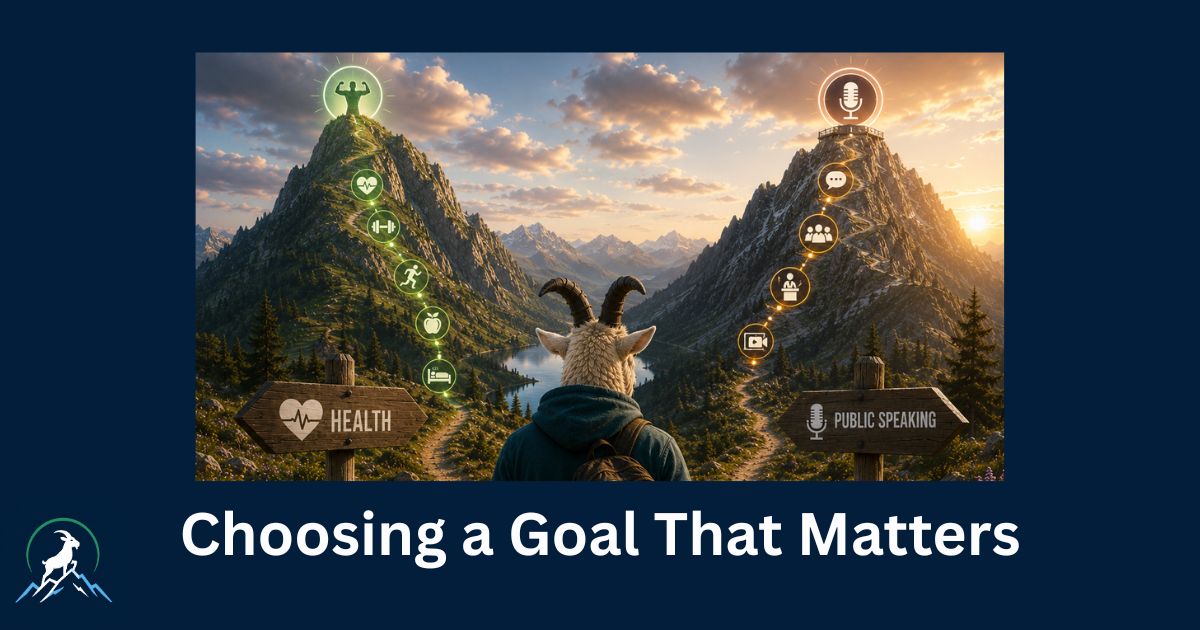
As someone whose entire lifestyle revolves around climbing mountains, I was relieved they began with a question that doesn't get asked nearly often enough:
How do you decide which mountain is worth climbing in the first place?
Humans spend an astonishing amount of energy discussing productivity, habits, discipline, routines, and motivation. Yet many of them never stop to ask whether they're heading in the right direction.
From where I'm standing, that seems backwards.
The fastest route to disappointment is discovering you've spent years climbing a mountain you never wanted to be on.
The Mountains We Choose for Other People
One of the first ideas that caught my attention came from Jores. He was talking about goals with expiration dates. You know the ones. Lose weight for the cruise. Look good for the reunion. Survive until the wedding photos have been taken.
Humans seem very fond of these goals. The problem is that once the event passes, the reason for climbing often disappears with it.
Mountains don't work that way.
The summit doesn't care why you started climbing. The only thing that matters is whether you're willing to keep going when the weather changes, your legs are tired, and nobody is watching.
What struck me most was the distinction between goals that are tied to an event and goals that are tied to identity. Wanting to become healthy is different from wanting to lose weight before a cruise. Wanting to become financially secure is different from wanting to impress somebody else.
The first changes who you are. The second usually disappears when the calendar page turns.
A Thought About Becoming
Anna challenged the idea that some goals never really end.
As I listened, I realized they were both describing different parts of the same climb.
Most goals begin with a destination. Humans like destinations. They want to know when they've arrived.
At the same time, the best goals seem to leave something behind after they are achieved.
A person who exercises consistently for a year doesn't just lose weight. They become someone who exercises consistently.
A person who spends a year improving their finances doesn't simply reach a number in a bank account. They develop habits, discipline, and awareness that stay with them.
From a mountain goat's perspective, this makes perfect sense.
The climb changes the climber.
In fact, that may be the entire point.
Why Health and Wealth Keep Appearing on the Map
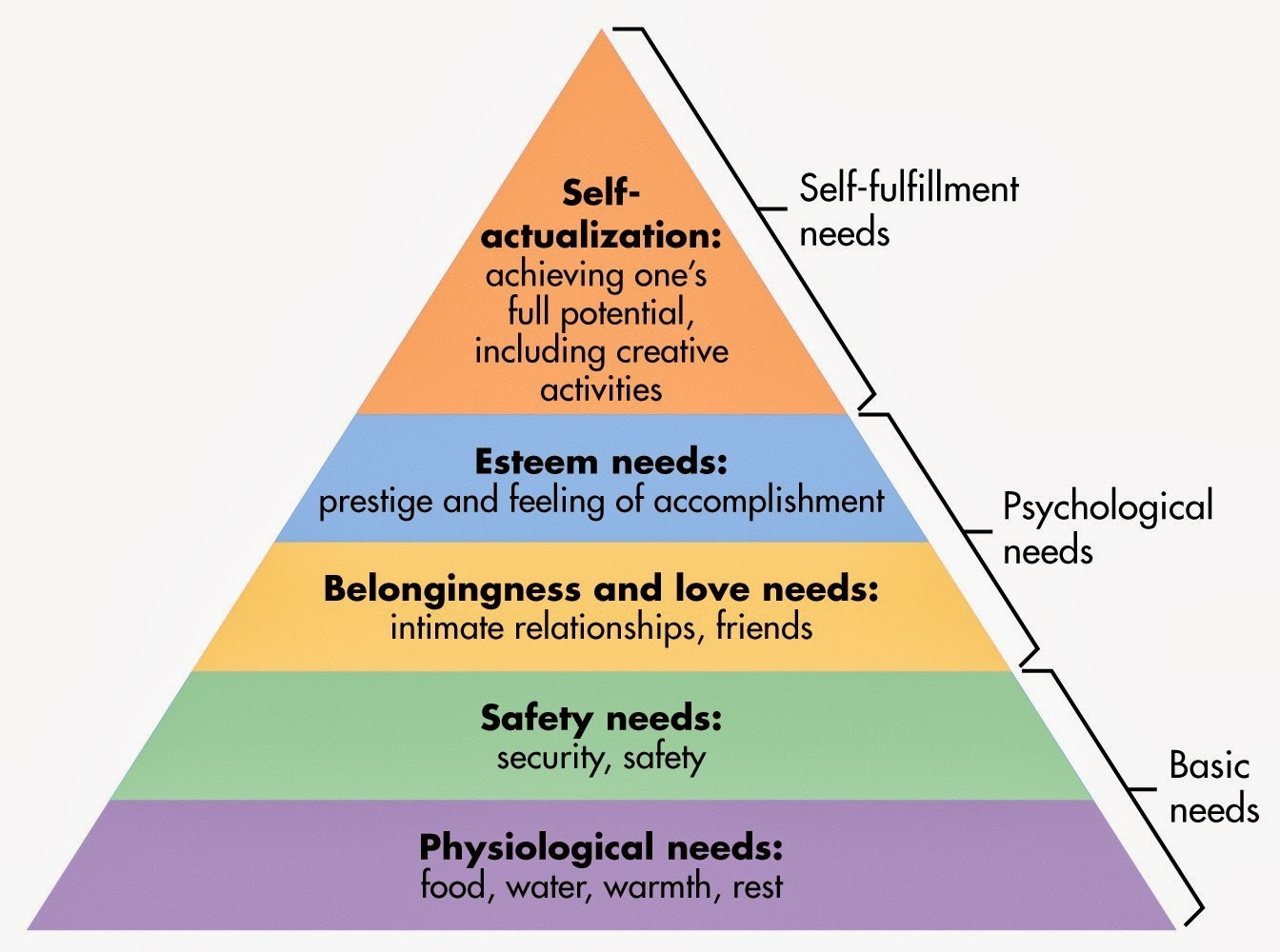
A large part of the conversation revolved around Maslow's Hierarchy of Needs.
Now, I am a mountain goat, not a psychologist, but the idea seemed straightforward enough.
If you are hungry, cold, exhausted, or worried about survival, it becomes difficult to think about higher aspirations.
This was reassuring because it turns out goats and humans are not so different after all.
If I'm hanging off a cliff wondering where my next meal is coming from, self-actualization is not my top priority.
Anna connected this idea to goal setting. She argued that if health and finances are struggling, those areas often deserve attention before many other pursuits.
The more I thought about it, the more it made sense.
Humans sometimes treat health and finances as boring topics. They want to focus on bigger dreams, more exciting ambitions, and grand visions for the future.
The irony is that poor health and financial stress have a remarkable ability to drag every other goal down the mountain with them.
That doesn't mean relationships, family, creativity, or personal fulfillment aren't important. They absolutely are. It simply means that a strong foundation makes the rest of the climb much easier.
Looking Across to Someone Else's Mountain
The conversation eventually turned to comparison.
This is another area where humans fascinate me.
A mountain goat can spend an entire day navigating steep cliffs without once wondering whether another goat is climbing faster.
Humans seem less fortunate.
Anna shared the example of another business owner who competes in Hyrox events at an incredibly high level. It would have been easy to look at those achievements and feel discouraged. Instead, she chose to focus on her own progress and celebrate a personal best running time.
That struck me as wise.
There will always be someone further ahead.
There will always be a taller mountain.
There will always be someone climbing it faster.
The question is not whether someone else is making progress. The question is whether you are making progress on the things that matter to you.
One of the simplest lessons from the episode was also one of the most important: your goal should be based on where you are, not where someone else is.
You have to start from your own mountain.
Dream Big, Climb One Step at a Time
Towards the end of the conversation, Anna said something that stayed with me.
It's good to dream big.
I agree.
If you're going to climb a mountain, it might as well be one worth climbing.
At the same time, every summit is reached the same way: one step at a time.
Humans often seem disappointed by this fact. They want breakthroughs, shortcuts, secret systems, and dramatic transformations.
Unfortunately, mountains remain stubbornly old-fashioned.
The path to the summit is usually made up of ordinary days repeated consistently.
A workout. A walk. A better decision. A difficult conversation. A small improvement.
Then another. And another.
The remarkable thing is what can happen over the course of a year. Anna mentioned that people often underestimate what they can accomplish in twelve months. Looking around at the mountains, I suspect she is right.
Most great climbs are not the result of a single heroic effort.
They are the result of many ordinary steps taken in the same direction.
The Question I'm Taking Away
When the conversation ended, I found myself returning to the same question that started it.
What goal matters most right now to you?
Not the goal that would impress other people. Not the goal that sounds good when someone asks what you're working on. Not the goal that belongs to your parents, your boss, your friends, or the stranger on social media who appears to have everything figured out.
Your goal.
The one that belongs to you.
The mountain that, for whatever reason, keeps calling your name.
Anna and Jores spent this episode talking about choosing a goal. What I took away from the conversation is that choosing the right goal may be more important than any productivity system, habit tracker, or planning method that comes afterwards.
After all, climbing efficiently is useful. But only if you're climbing the right mountain.
Until next time,
Plandore 🐐
Author
Anna Angelova