 9 min Read

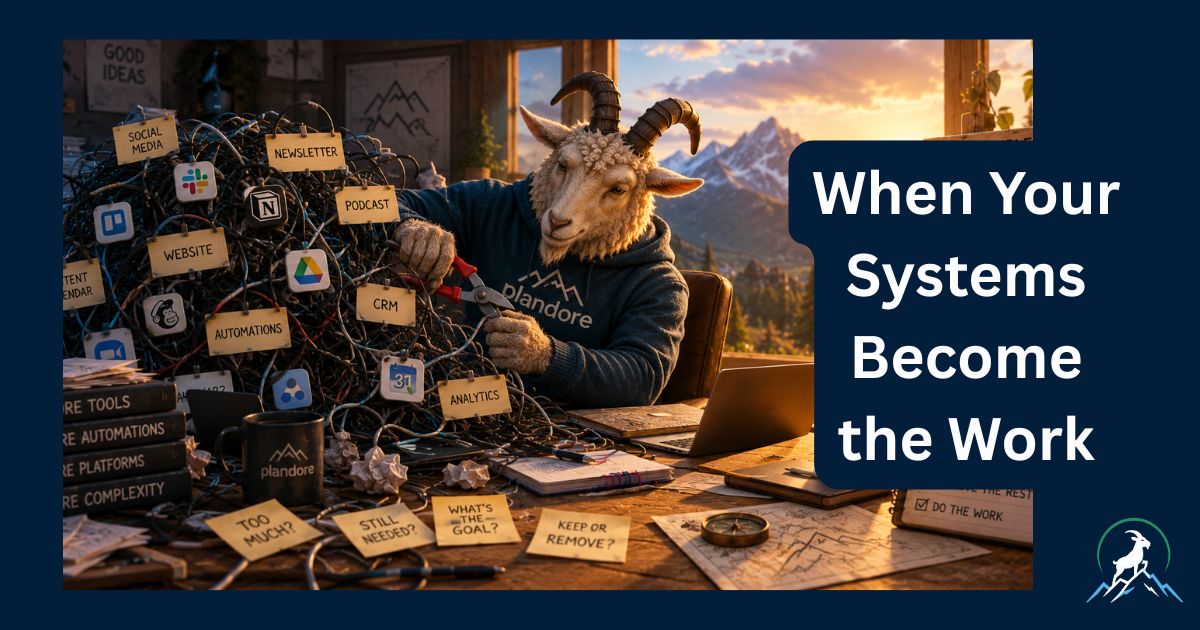
When Your Systems Become the Work
Notes from the Mountain
This week, Anna and Jores were supposed to be talking about marketing and they did. They talked about customers knowing, liking, and trusting you. They talked about websites, LinkedIn, content, referrals, webinars, social proof, newsletters, communities and even running shoes.
There were a lot of pieces. Which, strangely enough, became the part of the conversation I found most interesting.
Because somewhere near the end, Anna said something that had very little to do with marketing and quite a lot to do with productivity:
“Leave a system unchecked for long enough, and it naturally becomes more complicated.“
I looked around at the humans. Then at their apps, dashboards, and at the seventeen-step workflows they created to save themselves time.
She may have a point.
Systems Rarely Start Complicated
Most systems begin because we're trying to make something easier. You keep forgetting something, so you create a checklist. You want to exercise consistently, so you establish a morning routine. Your business needs customers, so you start posting on LinkedIn. You need to keep track of prospects, so you create a spreadsheet.
It works. Then something interesting happens. The system grows. The LinkedIn posts become a content calendar. The content calendar expands into a newsletter. Then there's a podcast. Someone tells you that you should be nurturing your audience by email. You add a CRM. Then an automation. Then another automation to connect the first automation to something else.
None of these decisions is necessarily wrong. In fact, that is precisely the problem. Each addition can make perfect sense on its own. It is only when you stand back and look at the whole thing that you wonder how "find some customers" turned into a machine requiring its own maintenance department.
That was essentially what Anna was wrestling with in the episode. She had been reading a book about content marketing and found plenty of useful ideas, but much of the system was designed for organizations far larger than her own. As a small business owner with limited time and resources, adding more wasn't necessarily the answer. She needed to get back to the basics.
Complexity Creeps In Quietly
I don't think we usually decide to make our lives unnecessarily complicated. It happens one reasonable decision at a time. We discover a new productivity method and borrow one part of it. We find an app that solves a problem and add it to the collection. We create another recurring meeting because something fell through the cracks. We add another field to the spreadsheet because we might need the information someday. We add another step to a process because of something that went wrong once.
Before long, we're maintaining systems that contain the history of every problem we've ever encountered. And because we built them ourselves, we rarely notice how complicated they've become. We know where everything is, why that strange extra step exists, and which notification can be ignored. We know that technically there are three places where the same information lives, but this is the one we actually use.
Until one day the system that was supposed to reduce friction starts creating it.
Productivity Isn't About Building More Systems
I spend quite a lot of time around productivity.
Occupational hazard.
And humans seem to have developed a peculiar relationship with systems. When something isn't working, the instinct is often to add something: new habit, new tool, new routine, new process, new automation, new productivity app…
I should probably be careful with that last one.
But a better system isn't necessarily a bigger system.
The purpose of a system is to make the things that matter easier to do consistently. If maintaining the system starts requiring more attention than the work it exists to support, something has gone wrong. You shouldn't need forty-five minutes to organize the work before you can begin the work. Your morning routine shouldn't be so elaborate that missing one step ruins the morning. Your business shouldn't require you to publish in seven places simply because seven places exist. And your task manager probably doesn't need a task reminding you to review the system you created to manage your tasks. Probably.
Sometimes You Have to Stop Adding
Toward the end of the conversation, Anna used an image I liked.
Pruning.
If you leave a bush alone, it grows. Branches cross. Some areas become overcrowded. Old growth consumes resources that could support something healthier.
The solution is to cut some branches away.
Anna suggested that we sometimes need to do the same thing with our businesses: disconnect for a while, step back and look at what we've built.
I think the same applies to almost every system in our lives.
Occasionally, we need to stop asking: What else should I add?
And start asking: What can I remove?
- Do I still need this?
- Why do I do it this way?
- What problem was this supposed to solve?
- Is that problem still there?
- What would happen if I stopped doing this altogether?
Those aren't particularly exciting questions. No one is going to launch a shiny new app called Delete Half Your Workflow. Although perhaps they should.
Go Back to What the System Is For
The interesting thing about Anna and Jores' marketing conversation was that once they stripped away all the tactics, they arrived at something remarkably simple.
People need to know you exist. They need to understand what you do and who you do it for. And eventually, they need to like and trust you enough to do business with you. Everything else (e.g. LinkedIn, newsletters, podcasts, webinars, networking, reviews, email sequences) is a possible way of helping that happen. These things are tools, not the objective.
Once you remember what a system is actually supposed to accomplish, you can evaluate every part of it against that purpose. Maybe you need the newsletter or maybe you don't. Maybe your complicated morning routine genuinely helps you start the day well or maybe three steps would accomplish exactly the same thing. Maybe the weekly report is essential or maybe nobody has read it since 2023. You can't know until you remember why the system exists.
Simple Doesn't Mean Easy
Jores made an important distinction during the conversation.
Marketing doesn't become easy when you prune it. It just becomes simple.
I think that's true of good systems in general. Running three times a week is simple but it isn't necessarily easy. Writing consistently is simple. Building a business around a clear offer for a specific customer can be simple. None of these things is easy.
Complexity can sometimes give us the illusion that we're solving the difficulty. We create another process. Research another method. Rearrange the system. Add another tool. And for a little while, all that activity feels productive.
But eventually we still have to do the hard thing. Perhaps the best systems don't remove the hard work. They remove everything that gets in the way of doing it.
Maybe Your System Needs a Pruning Day
So I've added a new question to my collection.
When was the last time you simplified something that was already working?
Habits accumulate, businesses evolve, priorities change, and something that made perfect sense two years ago may now be an extra branch blocking the light. Every once in a while, perhaps productivity requires us to stop optimizing the system and step outside it long enough to see what it has become.
Keep what helps. Remove what doesn't. Untangle what has become unnecessarily complicated. Then get back to the work the system was supposed to help you do in the first place.
That sounds suspiciously simple.
Good.
Continue the Conversation
This episode was the first More Than Just Task Management conversation recorded inside the newly resurrected Visionary Founders Club, a community Anna and Jores are building for business owners at different stages of the journey.
If you're building a solo practice, small business, or growing company and want a place to talk about the systems, habits, decisions and occasional mess involved in building something of your own, come join us.
Anna says building a business can be lonely and exhausting, as well as incredibly rewarding. The idea behind the group is that it doesn't have to be quite so lonely.
Join the Visionary Founders Club.
I'll be there presumably inspecting everyone's systems for unnecessary branches. 🐐
Author
Anna Angelova